
THE VENICE STATE ARCHIVE (ARCHIVIO DI STATO DI VENEZIA)
What is the Venice State Archive?
Firstly, I would say that the Venice State Archive is one of the biggest and beautiful archives in the world. Archivio di Stato di Venezia is one of the most valuable sources for historians who research the Mediterranean history and the Venetian Republic. The Venice State Archives were established in 1815 under the name of Archivio generale veneto (Venetian General Archives) in the Frari district. Between 1817 and 1822, the documents produced over a thousand years by the offices of the Serenissima, originally kept in the Doge’s Palace, the Procuratie Marciane or the palaces of Rialto, were transferred to the new institute. During the Napoleonic era, they had been moved to three different locations. In subsequent years, the archives produced during the Napoleonic period and by the Austrian governments were also added.
Since 1866, the archives produced by the Italian state offices located in Venice have been flowing in. The collection, which spans approximately 80 km of shelving, consists of over 800 fonds, some of which contain hundreds of other archives, as is the case with trade guilds, confraternities and notaries. The number of fonds is therefore likely to increase as these sources are catalogued within the information system. In the Venice State Archive, the documents date back to the 1200s and in terms of topic, stretch from the Eastern Mediterranean trade, Venice’s colonial territory, Venice’s terraferma, and diplomacy to the Senate register.
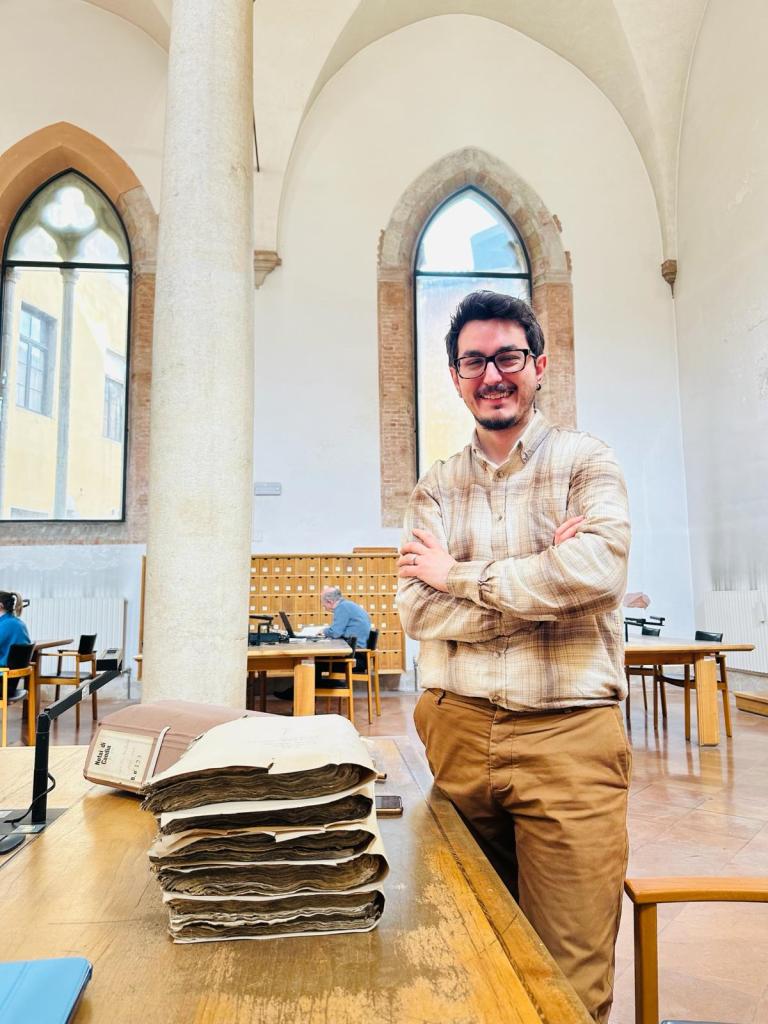
While I was studying as a visiting scholar at Ca’Foscari University between 2023 and 2024 for my PhD thesis, I found an opportunity to conduct research in the Venetian State Archive. Since I worked on Venetian Crete between 1204 and 1453, I delved into the documents about Crete, such as the Duca di Candia and the Notai di Candia. In addition to prosperous archival documents and books, working in the environment of the Frari Church, which dates back to the Middle Ages, is a wonderful feeling. Working alongside internationally renowned scientists in your field also makes you feel valued. For me, another advantage of working in the world’s best archive was being able to work on the same topics as my wife, who is also a Venetian Crete historian.
Finally, I would like to talk about the procedures for operating the archive. There are some rules, but they are not strict in the Venice State Archives. When you visit the Venice State Archive for the first time, you will be registered in the archive system by the archive staff along with your passport. You will be able to access the archive system to request documents using the username and password provided to you. After registering in the system, you will be able to start requesting records from the computers located next to the archive staff desk. You are entitled to receive three files per day, but you will need to wait approximately half an hour for the document to be given to you while you are there. However, if you request it from the system one day in advance, the document you want will most likely be ready the next day. Working days and hours are Monday to Friday from 8:30 a.m. to 6:00 p.m., except on Fridays when the hours are limited to 2:30 p.m. Regardless of the rules and working hours, the staff at the State Archives of Venice are very helpful and friendly, so you can be assured that technical issues will be addressed.
Every experience I had with the medieval documents at the State Archives of Venice was amazing, both for the staff and the academics.

WHY CRETE? WHY I CHOSE VENETIAN CRETE FOR MY RESEARCH?
Written by Emre Kaymakçı
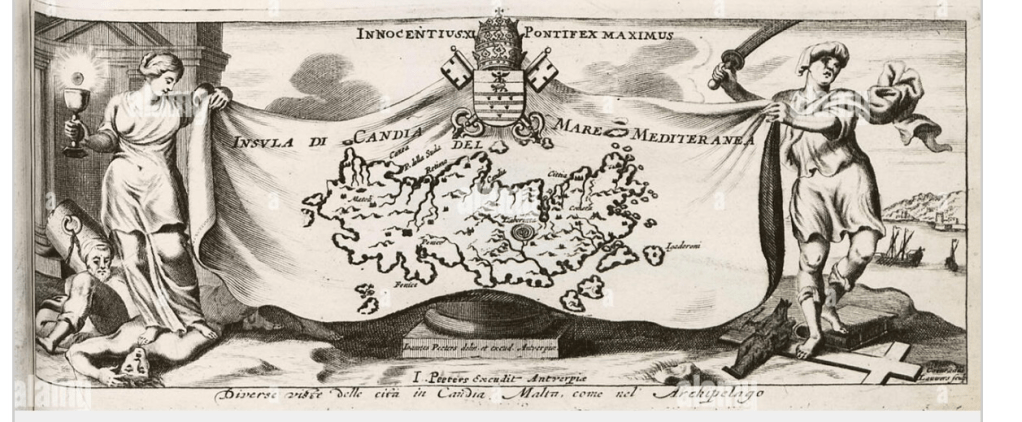
When I come across the question Why Crete? Or Why Venetian Crete? from people, I simply answer them: “I chose the island of Crete because of my grandparents, who came from Crete to İzmir in the early 20th century.” Surely, this is entirely an emotional reason for me. But on the other hand, this reason, as a historian, increased my existing curiosity for research even more. My passion for Crete academically began during my Bachelor’s time, when I was searching for the Minoan/Mycenean culture of Crete. The Minoan culture has fascinated me since my early university years. After successfully completing courses in Aegean and Greek History, I wrote an MA thesis titled “Struggle for Dominion in the Aegean Islands (Byzantines, Venetians, Turks)”. And while I was writing my thesis, I realised that Crete was not only strategically crucial in the Minoan culture, but also in the Middle Ages, particularly after Venice’s conquest following the Fourth Crusade. At that point, I had decided to study Venetian Crete (1204-1669).
There are several reasons why I chose Venetian Crete for my research. Firstly, I should say that before I wrote my PhD thesis on Venetian Crete, there were no studies in Turkey, even though there are many essential scholars who study Venetian Crete in the world. For this reason, I wanted to make a meaningful contribution to Turkish academia to fill the gap. I entered this field aware of the difficulties involved in studying Venetian Crete. The most critical challenges were the source languages and access to the Venetian Archives. Greek, Italian, and Latin are essential for studying Venetian Crete, so I took various language courses before travelling to Venice in 2023-2024 for my project. Also, after I went to Venice, I improved my medieval Latin palaeography by reading archival documents in the Venetian State Archives. Secondly, there were almost no sources in Turkey related to the Venetian Crete. To this end, I gained a scholarship abroad. I worked as a visiting scholar at Ca’Foscari University in Venice, where I had the opportunity to access documents related to Crete in the Venetian State Archives. After overcoming these challenges and completing my PhD thesis in August 2024, which I enjoyed writing, I received my doctorate.
The Venetian Republic began to expand mainly after AD 992 and 1082 by gaining privileges from the Byzantine Empire in the Eastern Mediterranean. But Venice’s rise to “superpower” status in the Eastern Mediterranean began with its conquest of Crete and its establishment as its main colony. After Venice conquered Crete in 1204/1205, it wanted to implement the same administrative system as in Venice and divided Crete into six parts. Venice then appointed a duke and sent its own citizens there in an attempt to establish a stronghold in Crete. After these dates, Venice utilised Crete in every sense and attempted to maintain its power by managing its affairs in the eastern Mediterranean from here until it lost the island to the Ottomans in 1669. The rebellions against Venetian rule on the island, the shipyard (Arsenale), palaces, fountains, church and other structures built by Venice, commercial products like vine and wheat, the land system, and Venice’s relations with the other states through the island provide a laboratory environment for today’s researchers.
Both during my doctoral studies and immediately after completing my PhD, I saw the economic, political and military wealth that existed in the Venetian Crete documents, which led me to come up with an innovative project idea related to Venetian Crete during the EU project seminars I attended after completing my doctorate. For me, Venetian Crete is not just an academic subject-it is an endless source of questions, connections, and inspiration for understanding the Mediterranean world.
 VenetianCrete